↓ Skip to main content

Computer Security – ESORICS 2005

Overview of attention for book
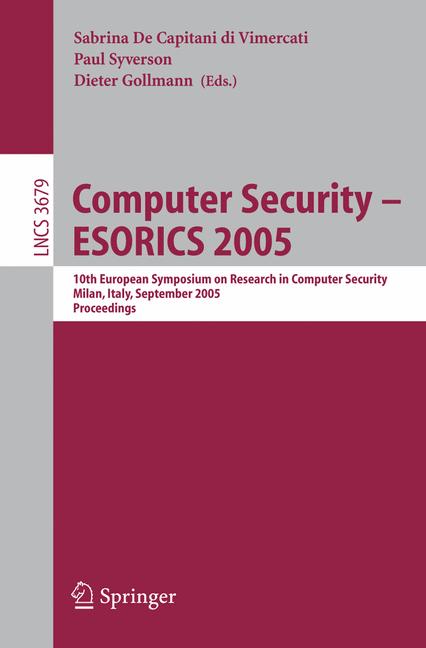
Cover of 'Computer Security – ESORICS 2005'

Table of Contents

  1. Altmetric Badge
    Book Overview
  2. Altmetric Badge
    Chapter 1 Computerized Voting Machines: A View from the Trenches
  3. Altmetric Badge
    Chapter 2 XML Access Control with Policy Matching Tree
  4. Altmetric Badge
    Chapter 3 Semantic Access Control Model: A Formal Specification
  5. Altmetric Badge
    Chapter 4 A Generic XACML Based Declarative Authorization Scheme for Java
  6. Altmetric Badge
    Chapter 5 Specification and Validation of Authorisation Constraints Using UML and OCL
  7. Altmetric Badge
    Chapter 6 Unified Index for Mobile Object Data and Authorizations
  8. Altmetric Badge
    Chapter 7 On Obligations
  9. Altmetric Badge
    Chapter 8 Computer Security – ESORICS 2005
  10. Altmetric Badge
    Chapter 9 Machine-Checked Security Proofs of Cryptographic Signature Schemes
  11. Altmetric Badge
    Chapter 10 Sanitizable Signatures
  12. Altmetric Badge
    Chapter 11 Limits of the Cryptographic Realization of Dolev-Yao-Style XOR
  13. Altmetric Badge
    Chapter 12 Security-Typed Languages for Implementation of Cryptographic Protocols: A Case Study
  14. Altmetric Badge
    Chapter 13 Augmented Oblivious Polynomial Evaluation Protocol and Its Applications
  15. Altmetric Badge
    Chapter 14 Using Attack Trees to Identify Malicious Attacks from Authorized Insiders
  16. Altmetric Badge
    Chapter 15 An Efficient and Unified Approach to Correlating, Hypothesizing, and Predicting Intrusion Alerts
  17. Altmetric Badge
    Chapter 16 Towards a Theory of Intrusion Detection
  18. Altmetric Badge
    Chapter 17 On Scalability and Modularisation in the Modelling of Network Security Systems
  19. Altmetric Badge
    Chapter 18 Sybil-Resistant DHT Routing
  20. Altmetric Badge
    Chapter 19 Botnet Tracking: Exploring a Root-Cause Methodology to Prevent Distributed Denial-of-Service Attacks
  21. Altmetric Badge
    Chapter 20 Quantifying Probabilistic Information Flow in Computational Reactive Systems
  22. Altmetric Badge
    Chapter 21 Enforcing Non-safety Security Policies with Program Monitors
  23. Altmetric Badge
    Chapter 22 Soundness of Formal Encryption in the Presence of Key-Cycles
  24. Altmetric Badge
    Chapter 23 Privacy Preserving Clustering
  25. Altmetric Badge
    Chapter 24 Abstractions Preserving Parameter Confidentiality
  26. Altmetric Badge
    Chapter 25 Minimal Disclosure in Hierarchical Hippocratic Databases with Delegation
  27. Altmetric Badge
    Chapter 26 Security Notions for Disk Encryption
  28. Altmetric Badge
    Chapter 27 Local View Attack on Anonymous Communication
  29. Altmetric Badge
    Chapter 28 Browser Model for Security Analysis of Browser-Based Protocols
Attention for Chapter 8: Computer Security – ESORICS 2005
Altmetric Badge

About this Attention Score

  • In the top 25% of all research outputs scored by Altmetric
  • High Attention Score compared to outputs of the same age (92nd percentile)
  • High Attention Score compared to outputs of the same age and source (88th percentile)

Mentioned by

patent
4 patents
wikipedia
2 Wikipedia pages

Readers on

mendeley
91 Mendeley
You are seeing a free-to-access but limited selection of the activity Altmetric has collected about this research output. Click here to find out more.
Article details
Chapter title
Computer Security – ESORICS 2005
Chapter number 8
Book title
Computer Security – ESORICS 2005
Published in
Lecture notes in computer science, January 2005
DOI 10.1007/11555827_8
Book ISBNs
978-3-54-028963-0, 978-3-54-031981-8
Authors

Sabrina de Capitani di Vimercati, Paul Syverson, Dieter Gollmann, David Chaum, Peter Y. A. Ryan, Steve Schneider, Chaum, David, Ryan, Peter Y. A., Schneider, Steve

Login to access the Attention Digest and the Sentiment Analysis related to this output.

Timeline Attention over time Attention Score history
Login to access the full charts related to this output.
Activity
Login to access the full charts related to this output.
Mendeley demographics

Mendeley demographics

The data shown below were compiled from readership statistics for 91 Mendeley readers of this research output. Click here to see the associated Mendeley record.
Login to view Mendeley reader trends over time.

Geographical breakdown

Geographical breakdown
Country Count As %
United Kingdom 2 2%
United States 1 1%
Singapore 1 1%
Luxembourg 1 1%
Denmark 1 1%
Germany 1 1%
Chile 1 1%
Unknown 83 91%

Demographic breakdown

Readers by professional status
Readers by professional status Count As %
Student > Ph. D. Student 21 23%
Student > Master 17 19%
Researcher 12 13%
Professor > Associate Professor 7 8%
Student > Postgraduate 5 5%
Other 17 19%
Unknown 12 13%
Readers by discipline
Readers by discipline Count As %
Computer Science 66 73%
Engineering 5 5%
Social Sciences 3 3%
Mathematics 1 1%
Physics and Astronomy 1 1%
Other 2 2%
Unknown 13 14%
Attention Score in Context

Attention Score in Context

This research output has an Altmetric Attention Score of 12. This is our high-level measure of the quality and quantity of online attention that it has received. This Attention Score, as well as the ranking and number of research outputs shown below, was calculated when the research output was last mentioned on 01 January 2025.
All research outputs
#3,728,571
of 34,054,827 outputs
Outputs from Lecture notes in computer science
#976
of 10,687 outputs
Outputs of similar age
#11,985
of 210,231 outputs
Outputs of similar age from Lecture notes in computer science
#32
of 292 outputs
Altmetric has tracked 34,054,827 research outputs across all sources so far. Compared to these this one has done well and is in the 88th percentile: it's in the top 25% of all research outputs ever tracked by Altmetric.
So far Altmetric has tracked 10,687 research outputs from this source. They typically receive a little more attention than average, with a mean Attention Score of 6.2. This one has done well, scoring higher than 89% of its peers.
Older research outputs will score higher simply because they've had more time to accumulate mentions. To account for age we can compare this Altmetric Attention Score to the 210,231 tracked outputs that were published within six weeks on either side of this one in any source. This one has done particularly well, scoring higher than 92% of its contemporaries.
We're also able to compare this research output to 292 others from the same source and published within six weeks on either side of this one. This one has done well, scoring higher than 88% of its contemporaries.