↓ Skip to main content

The Effects of Noise on Aquatic Life

Overview of attention for book
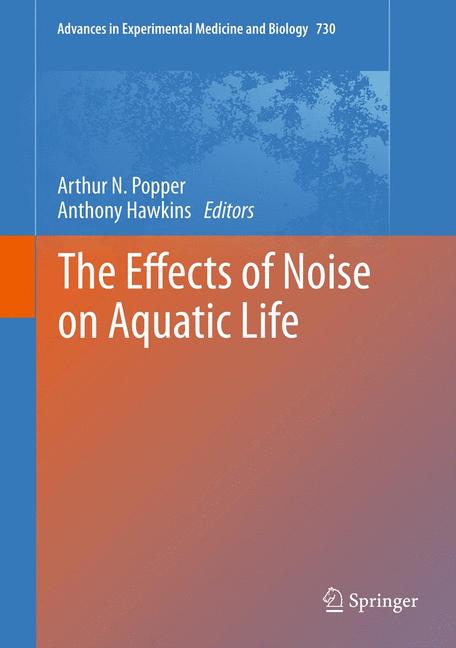
Cover of 'The Effects of Noise on Aquatic Life'

Table of Contents

  1. Book Overview
  2. Chapter 1 Noise and marine life: progress from nyborg to cork in science and technology to inform decision making.
  3. Chapter 2 Listening backward: early days of marine bioacoustics.
  4. Chapter 3 Effects of underwater noise on marine mammals.
  5. Chapter 4 Psychophysical studies of auditory masking in marine mammals: key concepts and new directions.
  6. Chapter 5 On the Relationship Between Environmental Noise, Critical Ratios, and Comodulation Masking Release in the Bottlenose Dolphin (Tursiops truncatus).
  7. Chapter 6 Direct measurements of subjective loudness in a bottlenose dolphin.
  8. Chapter 7 High auditory time resolution in bottlenose dolphins is effective protection against reverberation.
  9. Chapter 8 Frequency selectivity in the bottlenose dolphin auditory system.
  10. Chapter 9 Auditory Brain Stem Responses Associated with Echolocation in an Atlantic Bottlenose Dolphin (Tursiops truncatus).
  11. Chapter 10 Hearing, noise, and echolocating odontocetes.
  12. Chapter 11 Evoked potential audiometry in aquatic mammals.
  13. Chapter 12 Prediction of a Mysticete Audiogram via Finite Element Analysis of the Middle Ear.
  14. Chapter 13 Reverse engineering the cetacean ear to extract audiograms.
  15. Chapter 14 Validation of a vibroacoustic finite element model using bottlenose dolphin experiments.
  16. Chapter 15 Acoustic Function in the Peripheral Auditory System of Cuvier's Beaked Whale (Ziphius cavirostris).
  17. Chapter 16 Auditory evoked potential measurement of hearing sensitivity in pinnipeds.
  18. Chapter 17 Hearing in birds: what changes from air to water.
  19. Chapter 18 Amphibious hearing in sea turtles.
  20. Chapter 19 Hearing Capabilities of Loggerhead Sea Turtles (Caretta caretta) Throughout Ontogeny.
  21. Chapter 20 Are Sharks Even Bothered by a Noisy Environment?
  22. Chapter 21 Optimal auditory sensitivity under variable background noise conditions: a theoretical model.
  23. Chapter 22 A critical reevaluation of the role of acoustic pressure in source localization by fish.
  24. Chapter 23 Vibration of the otoliths in a teleost.
  25. Chapter 24 Hearing Sensitivity of the Painted Goby, Pomatoschistus pictus.
  26. Chapter 25 Acoustic Communication in Pomatoschistus spp.: A Comparison Between Closely Related Species.
  27. Chapter 26 Importance of Hearing for Survival of Danio rerio (Zebrafish) in an Experimental Predator/Prey Environment.
  28. Chapter 27 Lateral line canal morphology and noise reduction.
  29. Chapter 28 Potential for sound sensitivity in cephalopods.
  30. Chapter 29 Listening in noise.
  31. Chapter 30 Discovery of sound in the sea: an online resource.
  32. Chapter 31 Whistles of bottlenose dolphins: group repertoires and geographic variations in brazilian waters.
  33. Chapter 32 Detection and classification of vocalizations for the study of marine mammal distributions in the chukchi sea.
  34. Chapter 33 Acoustic ecology and behavior of minke whales in the hawaiian and marianas islands: localization, abundance estimation, and characterization of minke whale "boings".
  35. Chapter 34 What you see is not what you hear: the relationship between odontocete echolocation click production and hearing.
  36. Chapter 35 Sound Production and Reception in Southern Sea Otters (Enhydra lutris nereis).
  37. Chapter 36 Nocturnal Acoustic Activity in the Shallow Waters of the WWF-Miramare Natural Marine Reserve (Trieste, Italy).
  38. Chapter 37 Acoustic Ecology of the California Mantis Shrimp (Hemisquilla californiensis).
  39. Chapter 38 Influence of Turbidity on the Incidence of Sound Production in Atlantic Croaker (Micropogonias undulatus) in Pamlico Sound, North Carolina.
  40. Chapter 39 Propagation of lusitanian toadfish sounds in estuarine shallow waters.
  41. Chapter 40 Sound production in some physostomous fish species and effects of biological sounds on fish.
  42. Chapter 41 Is biological sound production important in the deep sea?
  43. Chapter 42 Unusual and Unexpected Biological Noisemakers in the Irish Sea and St. George's Channel.
  44. Chapter 43 Noise-induced hearing loss: from animal models to human trials.
  45. Chapter 44 Auditory effects of underwater noise in odontocetes.
  46. Chapter 45 Implementation of Acoustic Dosimeters With Recoverable Month-Long GPS/TDR Tags to Interpret Controlled-Exposure Experiments for Large Whales.
  47. Chapter 46 Marine mammal auditory system noise impacts: evidence and incidence.
  48. Chapter 47 Effect of broadband sounds on the auditory evoked potential thresholds in the beluga whale.
  49. Chapter 48 The ESME Workbench: Simulating the Impact of Anthropogenic Sound on Marine Mammals.
  50. Chapter 49 Using EarLab to Study Masking Due to Anthropogenic Sound.
  51. Chapter 50 Portable auditory evoked potential system to assess odontocete hearing.
  52. Chapter 51 Barotrauma in fish and barotrauma metrics.
  53. Chapter 52 Assessment of barotrauma injury and cumulative sound exposure level in salmon after exposure to impulsive sound.
  54. Chapter 53 Shipboard assessment of hearing sensitivity of tropical fishes immediately after exposure to seismic air gun emissions at scott reef.
  55. Chapter 54 A lack of correlation between air gun signal pressure waveforms and fish hearing damage.
  56. Chapter 55 Effects of Short-and Long-Term Exposure to Boat Noise on Cortisol Levels in Juvenile Fish.
  57. Chapter 56 Potential effects of long-term exposure to boat noise on the growth, survival, and nutrient retention in juvenile fish.
  58. Chapter 57 Predicting Hearing Loss in Fishes
  59. Chapter 58 Effects of Pile-Driving Noise on Oncorhynchus mykiss (Steelhead Trout).
  60. Chapter 59 Controlled exposure study of dolphins and sea lions to midfrequency sonarlike signals.
  61. Chapter 60 A direct comparison of bottlenose dolphin and common dolphin behavior during seismic surveys when air guns are and are not being utilized.
  62. Chapter 61 Behavioral reactions of harbor porpoise to pile-driving noise.
  63. Chapter 62 Effects of Offshore Pile Driving on Harbor Porpoises (Phocoena phocoena).
  64. Chapter 63 Evaluating the Effects of Offshore Pile Driving on Phocoena phocoena (Harbor Porpoises) by Using Passive Acoustic Monitoring.
  65. Chapter 64 Effects of underwater explosions on presence and habitat use of harbor porpoises in the german baltic sea.
  66. Chapter 65 Behavioral-response studies: problems with statistical power.
  67. Chapter 66 Detection and Tracking of Whales Using a Shipborne, 360° Thermal-Imaging System
  68. Chapter 67 Distribution of bowhead whale calls near an oil production island with fluctuating underwater sound.
  69. Chapter 68 Assessment of the Effect of Natural and Anthropogenic Aquatic Noise on Vaquita (Phocoena sinus) Through a Numerical Simulation.
  70. Chapter 69 Impacts of Anthropogenic Sounds on Phocoena phocoena (Harbor Porpoise).
  71. Chapter 70 Changes in vocal behavior of north atlantic right whales in increased noise.
  72. Chapter 71 Acoustic Compensation to Shipping and Air Gun Noise by Mediterranean Fin Whales (Balaenoptera physalus).
  73. Chapter 72 Long-Term Monitoring of Anthropogenic Noise and Its Relationship to Bottlenose Dolphin (Tursiops truncatus) Distribution in the Cres-Lošinj Archipelago, Northern Adriatic, Croatia.
  74. Chapter 73 Does Vessel Noise Affect the Use of Sound by Foraging Orcinus orca (Killer Whales)?
  75. Chapter 74 Do Silent Ships See More Fish? Comparison of a Noise-Reduced and a Conventional Research Vessel in Alaska
  76. Chapter 75 Behavioral observations of baleen whales in proximity of a modern fishing vessel.
  77. Chapter 76 Assessing Effects of an Acoustic Marine Geophysical Survey on the Locomotive Behavior of Bottlenose Dolphins, Tursiops truncatus.
  78. Chapter 77 Acoustic Monitoring of Beluga Whales (Delphinapterus leucas) in Cook Inlet, Alaska.
  79. Chapter 78 Soundscape of a nearshore coral reef near an urban center.
  80. Chapter 79 Gap durations in ambient noise impact the communication range of harp seals: a pilot study.
  81. Chapter 80 Importance of underwater sounds for migration of fish and aquatic mammals.
  82. Chapter 81 Behavioral Responses of Diamondback Terrapins (Malaclemys terrapin terrapin) to Recreational Boat Sounds.
  83. Chapter 82 Assessing disturbance from under-ice noise on fishes in boreal lakes.
  84. Chapter 83 Impacts of river-based air gun seismic activity on northern fishes.
  85. Chapter 84 Effects of Underwater Noise on Larval settlement
  86. Chapter 85 Does vessel noise change the calling rate and intensity of soniferous fishes?
  87. Chapter 86 Behavioral Responses of Captive Herring to Sonar Signals (1-1.6 kHz) of a Naval Frigate Throughout a Yearly Cycle.
  88. Chapter 87 Acoustic tagging: a suitable method for the study of natural herring behavior around spawning?
  89. Chapter 88 Effects of pile driving on the behavior of cod and sole.
  90. Chapter 89 A novel field study setup to investigate the behavior of fish related to sound.
  91. Chapter 90 Do Ocean-Based Wind Farms Alter the Migration Pattern in the Endangered European Silver Eel (Anguilla anguilla) Due to Noise Disturbance?
  92. Chapter 91 Effects of Vessel Engine Noise on the Acoustic Signaling Behavior of Dascyllus albisella (Hawaiian Damselfish).
  93. Chapter 92 Distribution and potential impact of boat noise on fish sound production from an autonomous acoustic array in the eastern gulf of Mexico.
  94. Chapter 93 Cichlid courtship acoustics: signals and noise influence reproductive behavior.
  95. Chapter 94 Using catch statistics to investigate effects of seismic activity on fish catch rates.
  96. Chapter 95 Effects of sounds from seismic air guns on fish behavior and catch rates.
  97. Chapter 96 A bioenergetics approach to developing a population consequences of acoustic disturbance model.
  98. Chapter 97 Energetic cost of behaviors performed in response to vessel disturbance: one link in the population consequences of acoustic disturbance model.
  99. Chapter 98 A common sense approach to source metrics.
  100. Chapter 99 Underwater sounds from unattenuated and attenuated marine pile driving.
  101. Chapter 100 What is the Source Level of Pile-Driving Noise in Water?
  102. Chapter 101 Ground roll waves as a potential influence on fish: measurement and analysis techniques.
  103. Chapter 102 Assessment of cumulative sound exposure levels for marine piling events.
  104. Chapter 103 Modeling the Propagation of Transient Sounds in Very Shallow Water Using Finite Difference Time Domain (FDTD) Calculations.
  105. Chapter 104 Proximate measurements of acoustic emissions associated with the installation and operation of an exploration jackup drilling rig in the north sea.
  106. Chapter 105 Measurement of underwater noise arising from marine aggregate operations.
  107. Chapter 106 Svein vaage broadband air gun study.
  108. Chapter 107 Cetacean hearing-damage zones around a seismic source.
  109. Chapter 108 Modeling cumulative sound exposure over large areas, multiple sources, and long durations.
  110. Chapter 109 Sound-recording systems for measuring sound levels during seismic surveys.
  111. Chapter 110 First Description of the Sound Pressure and Particle Velocity Components of the Ambient Noise and Boat Noise Recorded at the WWF-Miramare Natural Marine Reserve, Trieste, Italy.
  112. Chapter 111 Underwater particle acceleration induced by a wind turbine in the baltic sea.
  113. Chapter 112 Is the ocean really getting louder?
  114. Chapter 113 The Complexity of Noise Impact Assessments: From Birdsong to Fish Behavior
  115. Chapter 114 Extrapolating beyond chinchillas: behavioral response ambiguity through the lens of variable human responses to moderate wind farm noise.
  116. Chapter 115 Underwater noise effects from wave energy devices on marine mammals: a possible approach.
  117. Chapter 116 Physical biologists and biological physicists: combining biology and physics in research on the effects of noise on aquatic life.
  118. Chapter 117 "So, am I correct in my understanding that a decibel is the same as a hertz?": the quest for informed, objective environmental impact analysis of marine anthropogenic noise.
  119. Chapter 118 Environmental assessment of offshore wind power generation: effect on a noise budget.
  120. Chapter 119 Development and implementation of criteria for exposure of Western gray whales to oil and gas industry noise.
  121. Chapter 120 Strategic assessment of the risk posed to marine mammals by the use of air guns in the antarctic: concepts, methods, results, and controversies.
  122. Chapter 121 Establishing a safety zone for marine mammals due to underwater blasting.
  123. Chapter 122 The marine mammal protection act: a regulatory approach to identifying and minimizing acoustic-related impacts on marine mammals.
  124. Chapter 123 Noise-related stress and cumulative impact assessment.
  125. Chapter 124 Interim criteria for injury to fish from pile-driving activities: recent experiences.
  126. Chapter 125 Marine Mammal Acoustics Exposure Analysis Models Used in US Navy Environmental Impact Statements.
  127. Chapter 126 Status of the National Oceanic and Atmospheric Administration's Guidelines for Assessing Impacts of Anthropogenic Sound on Marine Mammals.
  128. Chapter 127 Regulatory assessments of the effects of noise: moving from threshold shift and injury to behavior.
  129. Chapter 128 United States bureau of ocean energy management, regulation and enforcement: filling data gaps to better understand the effects of anthropogenic noise on marine life.
  130. Chapter 129 Regulation of sound in the ocean: recent and future possible changes.
  131. Chapter 130 Marine bioacoustics and the regulation of fisheries.
  132. Chapter 131 Update From the OEER Association on Research Findings Associated With the Assessment of the Impacts of Seismic Exploration on Marine Invertebrates.
  133. Chapter 132 Managing underwater noise in European waters: implementing the marine strategy framework directive.
  134. Chapter 133 Acoustic-based cetacean detection in irish waters.
  135. Chapter 134 Real-time monitoring of noise in cetacean acoustic niches.
  136. Chapter 135 What does ecosystem acoustics reveal about marine mammals in the bering sea?
  137. Chapter 136 Ship traffic noise distribution in the strait of gibraltar: an exemplary case for monitoring global ocean noise using real-time technology now available for understanding the effects of noise on marine life.
  138. Chapter 137 Are there technological alternatives to air guns for oil and gas exploration to reduce potential noise impacts on cetaceans?
  139. Chapter 138 Modeling cumulative sound exposure along a seismic line to assess the risk of seismic research surveys on marine mammals in the antarctic treaty area.
  140. Chapter 139 North atlantic treaty organization marine mammal risk mitigation principles and guidelines.
  141. Chapter 140 Mitigating impacts of underwater noise from dredging on beluga whales in cook inlet, alaska.
  142. Chapter 141 Exploration and production sound and marine life joint industry programme: research progress and applications.
  143. Chapter 142 Managing anthropogenic underwater noise in the northwest territories, Canada.
  144. Chapter 143 SIRENA '10: Beyond the Mediterranean.
  145. Chapter 144 Planning is critical to ensure effective mitigation of naval activities.
  146. Chapter 145 Standardizing protected species observer requirements in the United States.
  147. Chapter 146 Using passive acoustics to monitor the presence of marine mammals during naval exercises.
  148. Chapter 147 Development of a national database and standards for protected species observer data in the United States.
  149. Chapter 148 Coordinated management of anthropogenic noise from offshore construction off sakhalin island for protection of the Western gray whale.
  150. Chapter 149 Workshop one: risk analysis.
  151. Chapter 150 Workshop two: long-term and cumulative effects of acoustic exposure along with other stressors.
  152. Chapter 151 Workshop three: approaches to behavioral analysis of responses to high-energy acoustic sources.
  153. Chapter 152 Workshop four: international regulatory issues.
  154. Chapter 153 Summing up.
  155. Chapter 154 Erratum: whistles of bottlenose dolphins: group repertoires and geographic variations in brazilian waters.
Attention for Chapter 81: Behavioral Responses of Diamondback Terrapins (Malaclemys terrapin terrapin) to Recreational Boat Sounds.

About this Attention Score

  • Average Attention Score compared to outputs of the same age and source

Mentioned by

twitter
1 X user

Readers on

mendeley
5 Mendeley
You are seeing a free-to-access but limited selection of the activity Altmetric has collected about this research output. Click here to find out more.
Article details
Chapter title
Behavioral Responses of Diamondback Terrapins (Malaclemys terrapin terrapin) to Recreational Boat Sounds.
Chapter number 81
Book title
The Effects of Noise on Aquatic Life
Published in
Advances in experimental medicine and biology, January 2012
DOI 10.1007/978-1-4419-7311-5_81
Pubmed ID
Book ISBNs
978-1-4419-7310-8, 978-1-4419-7311-5
Authors

Lori A. Lester, Edward A. Standora, Walter F. Bien, Harold W. Avery, Lori A. Lester, Edward A. Standora, Walter F. Bien, Harold W. Avery, Lester, Lori A., Standora, Edward A., Bien, Walter F., Avery, Harold W.

Editors

Arthur N. Popper, Anthony Hawkins

Login to access the Attention Digest and the Sentiment Analysis related to this output.

Timeline Attention over time Attention Score history
Login to access the full charts related to this output.
Activity
Login to access the full charts related to this output.
X Demographics

X Demographics

The data shown below were collected from the profile of 1 X user who shared this research output. Click here to find out more about how the information was compiled.
Mendeley demographics

Mendeley demographics

The data shown below were compiled from readership statistics for 5 Mendeley readers of this research output. Click here to see the associated Mendeley record.
Login to view Mendeley reader trends over time.

Geographical breakdown

Geographical breakdown
Country Count As %
Unknown 5 100%

Demographic breakdown

Readers by professional status
Readers by professional status Count As %
Student > Bachelor 2 40%
Professor 1 20%
Researcher 1 20%
Unknown 1 20%
Readers by discipline
Readers by discipline Count As %
Agricultural and Biological Sciences 3 60%
Nursing and Health Professions 1 20%
Unknown 1 20%
Attention Score in Context

Attention Score in Context

This research output has an Altmetric Attention Score of 1. This is our high-level measure of the quality and quantity of online attention that it has received. This Attention Score, as well as the ranking and number of research outputs shown below, was calculated when the research output was last mentioned on 06 March 2020.
All research outputs
#15,381,871
of 22,884,315 outputs
Outputs from Advances in experimental medicine and biology
#2,507
of 4,952 outputs
Outputs of similar age
#163,805
of 244,722 outputs
Outputs of similar age from Advances in experimental medicine and biology
#74
of 130 outputs
Altmetric has tracked 22,884,315 research outputs across all sources so far. This one is in the 22nd percentile – i.e., 22% of other outputs scored the same or lower than it.
So far Altmetric has tracked 4,952 research outputs from this source. They typically receive a little more attention than average, with a mean Attention Score of 6.1. This one is in the 37th percentile – i.e., 37% of its peers scored the same or lower than it.
Older research outputs will score higher simply because they've had more time to accumulate mentions. To account for age we can compare this Altmetric Attention Score to the 244,722 tracked outputs that were published within six weeks on either side of this one in any source. This one is in the 21st percentile – i.e., 21% of its contemporaries scored the same or lower than it.
We're also able to compare this research output to 130 others from the same source and published within six weeks on either side of this one. This one is in the 30th percentile – i.e., 30% of its contemporaries scored the same or lower than it.