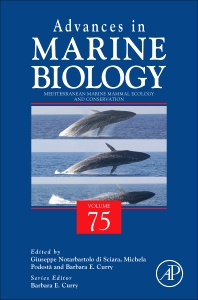
| Chapter title |
Dolphins in a Scaled-Down Mediterranean: The Gulf of Corinth's Odontocetes
|
|---|---|
| Book title |
Mediterranean Marine Mammal Ecology and Conservation
|
| Published in |
Advances in Marine Biology, January 2016
|
| DOI | 10.1016/bs.amb.2016.07.003 |
| Pubmed ID | |
| Book ISBNs |
978-0-12-805152-8
|
| Authors |
G. Bearzi, S. Bonizzoni, N.L. Santostasi, N.B. Furey, L. Eddy, V.D. Valavanis, O. Gimenez |
| Abstract |
The Gulf of Corinth is a 2400-km(2) semi-enclosed inland system (a mediterraneus) in central Greece. Its continental shelf areas, steep bottom relief, and waters up to 500-900m deep offer suitable habitat to neritic and pelagic species. We used photographic capture-recapture, distribution modelling, and direct observations to investigate the abundance, status, habitat preferences, movements, and group size of four odontocete species regularly observed in the Gulf, based on five years (2011-2015) of survey effort from small boats. Striped dolphins (Stenella coeruleoalba) are more abundant (1324 individuals, 95%CI 1158-1515) than was determined from previous estimates. Striped dolphins appear to be confined to the Gulf, where they favour deep and oligotrophic waters, and were encountered in single-species and mixed-species groups. Short-beaked common dolphins (Delphinus delphis) (22 individuals, 95%CI 16-31), individuals with intermediate pigmentation (possibly striped/common dolphin hybrids) (55, 95%CI 36-83), and a single Risso's dolphin (Grampus griseus) were only encountered in mixed-species groups with striped dolphins. Short-beaked common dolphins constitute a discrete conservation unit (subpopulation), and based on the current estimate, would qualify as Critically Endangered according to International Union for the Conservation of Nature (IUCN) Red List criteria. Common bottlenose dolphins (Tursiops truncatus) (39 animals, 95%CI 33-47) occur in single-species groups; they prefer continental shelf waters and areas near fish farms in the northern sector, and several animals appear to move into and out of the Gulf. Additionally, we contribute records of marine fauna and an assessment of the fishing fleet operating in the Gulf. Our study shows that the importance of this vulnerable marine environment has been underestimated, and management action must be taken to mitigate human impact and ensure long-term protection. |

Login to access the Attention Digest and the Sentiment Analysis related to this output.


X Demographics
Geographical breakdown
| Country | Count | As % |
|---|---|---|
| Philippines | 1 | 25% |
| France | 1 | 25% |
| Papua New Guinea | 1 | 25% |
| Unknown | 1 | 25% |
Demographic breakdown
| Type | Count | As % |
|---|---|---|
| Members of the public | 2 | 50% |
| Scientists | 2 | 50% |
Mendeley demographics
Geographical breakdown
| Country | Count | As % |
|---|---|---|
| South Africa | 1 | 1% |
| Unknown | 79 | 99% |
Demographic breakdown
| Readers by professional status | Count | As % |
|---|---|---|
| Researcher | 16 | 20% |
| Student > Ph. D. Student | 11 | 14% |
| Student > Master | 10 | 13% |
| Student > Bachelor | 7 | 9% |
| Other | 6 | 8% |
| Other | 11 | 14% |
| Unknown | 19 | 24% |
| Readers by discipline | Count | As % |
|---|---|---|
| Agricultural and Biological Sciences | 28 | 35% |
| Environmental Science | 18 | 23% |
| Earth and Planetary Sciences | 3 | 4% |
| Engineering | 3 | 4% |
| Biochemistry, Genetics and Molecular Biology | 2 | 3% |
| Other | 3 | 4% |
| Unknown | 23 | 29% |