| Chapter title |
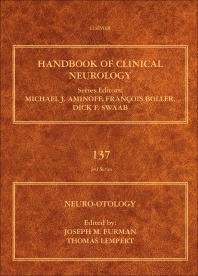
Neuro-Otology
|
|---|---|
| Book title |
Neuro-Otology
|
| Published in |
Handbook of clinical neurology, January 2016
|
| DOI | 10.1016/b978-0-444-63437-5.00021-2 |
| Pubmed ID | |
| Book ISBNs |
978-0-444-63437-5
|
| Authors |
Szczupak, M, Hoffer, M E, Murphy, S, Balaban, C D, M. Szczupak, M.E. Hoffer, S. Murphy, C.D. Balaban |
| Abstract |
Traumatic brain injury is an increasingly common public health issue, with the mild variant most clinically relevant for this chapter. Common causes of mild traumatic brain injury (mTBI) include motor vehicle accidents, athletics, and military training/deployment. Despite a range of clinically available testing platforms, diagnosis of mTBI remains challenging. Symptoms are primarily neurosensory, and include dizziness, hearing problems, headaches, cognitive, and sleep disturbances. Dizziness is nearly universally present in all mTBI patients, and is the easiest symptom to objectify for diagnosis. Aside from a thorough history and physical exam, in the near future specialized vestibular function tests will be key to mTBI diagnosis. A battery of oculomotor (antisaccade, predictive saccade) and vestibular tasks (head impulse test) has been demonstrated to sensitively and specifically identify individuals with acute mTBI. Vestibular therapy and rehabilitation have shown improvements for mTBI patients in cognitive function, ability to return to activities of daily living, and ability to return to work. Dizziness, as a contributor to short- and long-term disability following mTBI, is ultimately crucial not only for diagnosis but also for treatment. |

Login to access the Attention Digest and the Sentiment Analysis related to this output.


X Demographics
Geographical breakdown
| Country | Count | As % |
|---|---|---|
| United States | 1 | 100% |
Demographic breakdown
| Type | Count | As % |
|---|---|---|
| Members of the public | 1 | 100% |
Mendeley demographics
Geographical breakdown
| Country | Count | As % |
|---|---|---|
| Unknown | 130 | 100% |
Demographic breakdown
| Readers by professional status | Count | As % |
|---|---|---|
| Researcher | 18 | 14% |
| Student > Bachelor | 12 | 9% |
| Student > Master | 12 | 9% |
| Student > Ph. D. Student | 11 | 8% |
| Other | 10 | 8% |
| Other | 33 | 25% |
| Unknown | 34 | 26% |
| Readers by discipline | Count | As % |
|---|---|---|
| Medicine and Dentistry | 43 | 33% |
| Neuroscience | 17 | 13% |
| Nursing and Health Professions | 10 | 8% |
| Social Sciences | 4 | 3% |
| Agricultural and Biological Sciences | 3 | 2% |
| Other | 14 | 11% |
| Unknown | 39 | 30% |