↓ Skip to main content

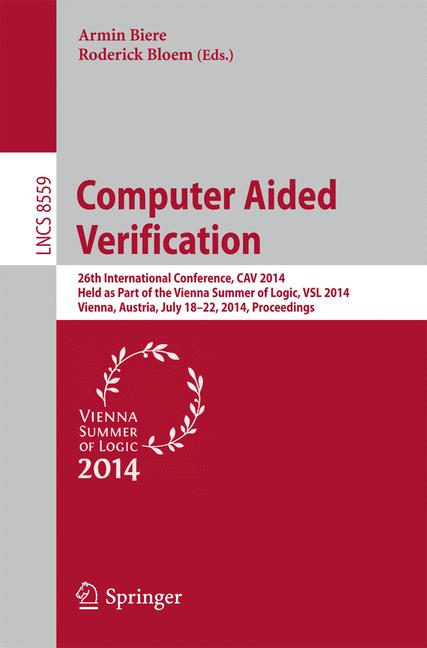
Computer Aided Verification

Overview of attention for book
Cover of 'Computer Aided Verification'

Table of Contents

  1. Book Overview
  2. Chapter 1 The Spirit of Ghost Code
  3. Chapter 2 SMT-Based Model Checking for Recursive Programs
  4. Chapter 3 Property-Directed Shape Analysis
  5. Chapter 4 Shape Analysis via Second-Order Bi-Abduction
  6. Chapter 5 ICE: A Robust Framework for Learning Invariants
  7. Chapter 6 From Invariant Checking to Invariant Inference Using Randomized Search
  8. Chapter 7 SMACK: Decoupling Source Language Details from Verifier Implementations
  9. Chapter 8 Synthesis of Masking Countermeasures against Side Channel Attacks
  10. Chapter 9 Temporal Mode-Checking for Runtime Monitoring of Privacy Policies
  11. Chapter 10 String Constraints for Verification
  12. Chapter 11 A Conference Management System with Verified Document Confidentiality
  13. Chapter 12 Vac - Verifier of Administrative Role-Based Access Control Policies
  14. Chapter 13 From LTL to Deterministic Automata: A Safraless Compositional Approach
  15. Chapter 14 Symbolic Visibly Pushdown Automata
  16. Chapter 15 Engineering a Static Verification Tool for GPU Kernels
  17. Chapter 16 Lazy Annotation Revisited
  18. Chapter 17 Interpolating Property Directed Reachability
  19. Chapter 18 Verifying Relative Error Bounds Using Symbolic Simulation
  20. Chapter 19 Regression Test Selection for Distributed Software Histories
  21. Chapter 20 GPU-Based Graph Decomposition into Strongly Connected and Maximal End Components
  22. Chapter 21 Software Verification in the Google App-Engine Cloud
  23. Chapter 22 The nuXmv Symbolic Model Checker
  24. Chapter 23 Analyzing and Synthesizing Genomic Logic Functions
  25. Chapter 24 Computer Aided Verification
  26. Chapter 25 Invariant Verification of Nonlinear Hybrid Automata Networks of Cardiac Cells
  27. Chapter 26 Diamonds Are a Girl’s Best Friend: Partial Order Reduction for Timed Automata with Abstractions
  28. Chapter 27 Reachability Analysis of Hybrid Systems Using Symbolic Orthogonal Projections
  29. Chapter 28 Verifying LTL Properties of Hybrid Systems with K-Liveness
  30. Chapter 29 Safraless Synthesis for Epistemic Temporal Specifications
  31. Chapter 30 Minimizing Running Costs in Consumption Systems
  32. Chapter 31 Computer Aided Verification
  33. Chapter 32 Optimal Guard Synthesis for Memory Safety
  34. Chapter 33 Don’t Sit on the Fence
  35. Chapter 34 MCMAS-SLK: A Model Checker for the Verification of Strategy Logic Specifications
  36. Chapter 35 Solving Games without Controllable Predecessor
  37. Chapter 36 G4LTL-ST : Automatic Generation of PLC Programs
  38. Chapter 37 Automatic Atomicity Verification for Clients of Concurrent Data Structures
  39. Chapter 38 Regression-Free Synthesis for Concurrency
  40. Chapter 39 Bounded Model Checking of Multi-threaded C Programs via Lazy Sequentialization
  41. Chapter 40 An SMT-Based Approach to Coverability Analysis
  42. Chapter 41 LEAP: A Tool for the Parametrized Verification of Concurrent Datatypes
  43. Chapter 42 Monadic Decomposition
  44. Chapter 43 A DPLL( T ) Theory Solver for a Theory of Strings and Regular Expressions
  45. Chapter 44 Bit-Vector Rewriting with Automatic Rule Generation
  46. Chapter 45 Computer Aided Verification
  47. Chapter 46 Computer Aided Verification
  48. Chapter 47 Automating Separation Logic with Trees and Data
  49. Chapter 48 A Nonlinear Real Arithmetic Fragment
  50. Chapter 49 Yices 2.2
  51. Chapter 50 A Simple and Scalable Static Analysis for Bound Analysis and Amortized Complexity Analysis
  52. Chapter 51 Symbolic Resource Bound Inference for Functional Programs
  53. Chapter 52 Proving non-termination using max-SMT
  54. Chapter 53 Termination Analysis by Learning Terminating Programs
  55. Chapter 54 Causal Termination of Multi-threaded Programs
  56. Chapter 55 Counterexample to Induction-Guided Abstraction-Refinement (CTIGAR)
  57. Chapter 56 Unbounded Scalable Verification Based on Approximate Property-Directed Reachability and Datapath Abstraction
  58. Chapter 57 QUICr: A Reusable Library for Parametric Abstraction of Sets and Numbers
Attention for Chapter 45: Computer Aided Verification

About this Attention Score

  • Average Attention Score compared to outputs of the same age
  • Above-average Attention Score compared to outputs of the same age and source (54th percentile)

Mentioned by

wikipedia
2 Wikipedia pages

Readers on

mendeley
18 Mendeley
You are seeing a free-to-access but limited selection of the activity Altmetric has collected about this research output. Click here to find out more.
Article details
Chapter title
Computer Aided Verification
Chapter number 45
Book title
Computer Aided Verification
Published in
Lecture notes in computer science, January 2014
DOI 10.1007/978-3-319-08867-9_45
Book ISBNs
978-3-31-908866-2, 978-3-31-908867-9
Authors

Armin Biere, Roderick Bloem, Liana Hadarean, Kshitij Bansal, Dejan Jovanović, Clark Barrett, Cesare Tinelli, Hadarean, Liana, Bansal, Kshitij, Jovanović, Dejan, Barrett, Clark, Tinelli, Cesare

Login to access the Attention Digest and the Sentiment Analysis related to this output.

Timeline Attention over time Attention Score history
Login to access the full charts related to this output.
Activity
Login to access the full charts related to this output.
Mendeley demographics

Mendeley demographics

The data shown below were compiled from readership statistics for 18 Mendeley readers of this research output. Click here to see the associated Mendeley record.
Login to view Mendeley reader trends over time.

Geographical breakdown

Geographical breakdown
Country Count As %
Japan 1 6%
Unknown 17 94%

Demographic breakdown

Readers by professional status
Readers by professional status Count As %
Student > Ph. D. Student 5 28%
Student > Bachelor 3 17%
Student > Master 3 17%
Researcher 2 11%
Professor > Associate Professor 1 6%
Other 0 0%
Unknown 4 22%
Readers by discipline
Readers by discipline Count As %
Computer Science 13 72%
Mathematics 1 6%
Unknown 4 22%
Attention Score in Context

Attention Score in Context

This research output has an Altmetric Attention Score of 3. This is our high-level measure of the quality and quantity of online attention that it has received. This Attention Score, as well as the ranking and number of research outputs shown below, was calculated when the research output was last mentioned on 13 August 2026.
All research outputs
#8,339,136
of 24,937,289 outputs
Outputs from Lecture notes in computer science
#2,526
of 8,148 outputs
Outputs of similar age
#96,804
of 318,173 outputs
Outputs of similar age from Lecture notes in computer science
#105
of 282 outputs
Altmetric has tracked 24,937,289 research outputs across all sources so far. This one is in the 43rd percentile – i.e., 43% of other outputs scored the same or lower than it.
So far Altmetric has tracked 8,148 research outputs from this source. They typically receive a little more attention than average, with a mean Attention Score of 5.2. This one has gotten more attention than average, scoring higher than 53% of its peers.
Older research outputs will score higher simply because they've had more time to accumulate mentions. To account for age we can compare this Altmetric Attention Score to the 318,173 tracked outputs that were published within six weeks on either side of this one in any source. This one is in the 47th percentile – i.e., 47% of its contemporaries scored the same or lower than it.
We're also able to compare this research output to 282 others from the same source and published within six weeks on either side of this one. This one has gotten more attention than average, scoring higher than 54% of its contemporaries.