↓ Skip to main content

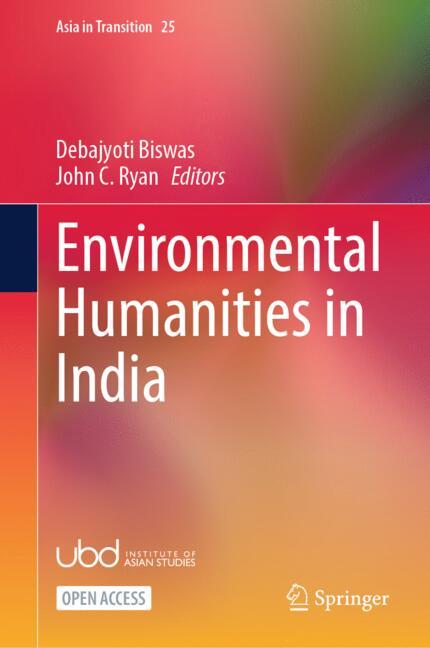
Environmental Humanities in India

Overview of attention for book
Cover of 'Environmental Humanities in India'

Table of Contents

  1. Altmetric Badge
    Book Overview
  2. Altmetric Badge
    Chapter 1 Environmental Humanities in India: An Interdisciplinary Approach
  3. Altmetric Badge
    Chapter 2 Indigenous Native Epistemology as a Model in Environmental Humanities in India
  4. Altmetric Badge
    Chapter 3 The Environment in Hindu Consciousness: Revisiting the Sacred Texts
  5. Altmetric Badge
    Chapter 4 Cultural Practices and Indigenous Traditions of the Garo and Bodo: Reinterpreting ‘Man-Nature’ Convergences in Wangala and Bathou
  6. Altmetric Badge
    Chapter 5 Indigenous Nature Conservation in Meghalaya: Environmental and Religious Dimensions of Tribal Land Ownership Among the Khasi Community
  7. Altmetric Badge
    Chapter 6 Philosophy for Environmental Policy and Law
  8. Altmetric Badge
    Chapter 7 Derangement in Ecological Consciousness Today
  9. Altmetric Badge
    Chapter 8 Multispecies Conviviality, Bioregionalism, and Vegetal Politics in Kodagu, India
  10. Altmetric Badge
    Chapter 9 “When the Black Half of the Kunni Seed Whitens”: Plant-Lore and the Plantationocene in Ambikasuthan Mangad’s Swarga
  11. Altmetric Badge
    Chapter 10 Mourning the Loss of Mother Earth: Examining Human-Water Interrelationships in Akkineni Kutumbarao’s Softly Dies a Lake
  12. Altmetric Badge
    Chapter 11 Constructing Ecotopian Space as a Protest Against the Urban Worldview in Bibhutibhusan Bandyopadhyay’s Literary Oeuvre
  13. Altmetric Badge
    Chapter 12 Connecting and Creating Narratives: Interrogating Myth, Legends, and the Anthropocene in Amitav Ghosh’s Gun Island
  14. Altmetric Badge
    Chapter 13 Amitav Ghosh’s Storyworlds for Environmental Dwelling: Multimodal Iterations and Performativity in/of Jungle Nama: A Story of the Sundarban
  15. Altmetric Badge
    Chapter 14 The Anthropocene in South Asian Popular Music: A Critical Examination of Papon’s “Waise Hi Rehna, Waise Hi Behna” Through an Ecomusicological Lens
Overall attention for this book and its chapters
Altmetric Badge

About this Attention Score

  • Good Attention Score compared to outputs of the same age (68th percentile)

Mentioned by

twitter
3 X users
bluesky
1 Bluesky user
You are seeing a free-to-access but limited selection of the activity Altmetric has collected about this research output. Click here to find out more.
Article details
Title
Environmental Humanities in India
Published by
Asia in Transition, January 2025
DOI 10.1007/978-981-97-3933-2
ISBNs
978-9-81-973932-5, 978-9-81-973933-2
Editors

Biswas, Debajyoti, Ryan, John C.

Login to access the Attention Digest and the Sentiment Analysis related to this output.

Timeline Attention over time Attention Score history
Login to access the full charts related to this output.
X Demographics

X Demographics

The data shown below were collected from the profiles of 3 X users who shared this research output. Click here to find out more about how the information was compiled.
Attention Score in Context

Attention Score in Context

This research output has an Altmetric Attention Score of 4. This is our high-level measure of the quality and quantity of online attention that it has received. This Attention Score, as well as the ranking and number of research outputs shown below, was calculated when the research output was last mentioned on 07 April 2025.
All research outputs
#9,744,994
of 29,433,032 outputs
Outputs from Asia in Transition
#23
of 39 outputs
Outputs of similar age
#113,083
of 362,640 outputs
Outputs of similar age from Asia in Transition
#1
of 3 outputs
Altmetric has tracked 29,433,032 research outputs across all sources so far. This one has received more attention than most of these and is in the 66th percentile.
So far Altmetric has tracked 39 research outputs from this source. They receive a mean Attention Score of 4.4. This one scored the same or higher as 16 of them.
Older research outputs will score higher simply because they've had more time to accumulate mentions. To account for age we can compare this Altmetric Attention Score to the 362,640 tracked outputs that were published within six weeks on either side of this one in any source. This one has gotten more attention than average, scoring higher than 68% of its contemporaries.
We're also able to compare this research output to 3 others from the same source and published within six weeks on either side of this one. This one has scored higher than all of them